

Faculty at Jesuit colleges and universities throughout the world are keenly aware of the Jesuit philosophy of Magis as it applies to the educational experience that is uniquely Ignatian. We are constantly seeking ways to “do more” as we aspire to provide a truly transformative education for our students.
As the higher education landscape continues to change, leading educators are fully aware that they need to be ahead of the curve in navigating these changing times. Eight years ago, The University of Scranton began charting a course that has reignited our pedagogy while putting a Jesuit education into action in our community and providing our students with unique, engaging learning experiences.
In 2017, The University of Scranton formally launched the Office of Community-Based Learning (CBL) in response to a Strategic Planning process that sought ways to grow service learning. In CBL, we saw a form of teaching, learning and community partnerships that is grounded in Ignatian pedagogy and puts that into action.
Today, Scranton’s CBL Office, under the direction of the provost, is supported by me as the faculty coordinator, with a CBL Board comprised of faculty, staff and administrators, as well as the Associate Vice President for Community Engagement & Government Affairs and the Assistant Director for Community & Civic Engagement in the Office of Community Relations.
Across all three colleges, CBL is part of the curriculum. In 2023-2024, 2,362 students engaged in academic CBL through courses or in activities related to their academic program, for a total of 31,373 hours. This includes 2,129 students from Scranton’s Leahy College of Health Science (LCHS), which has a longstanding CBL graduation requirement.
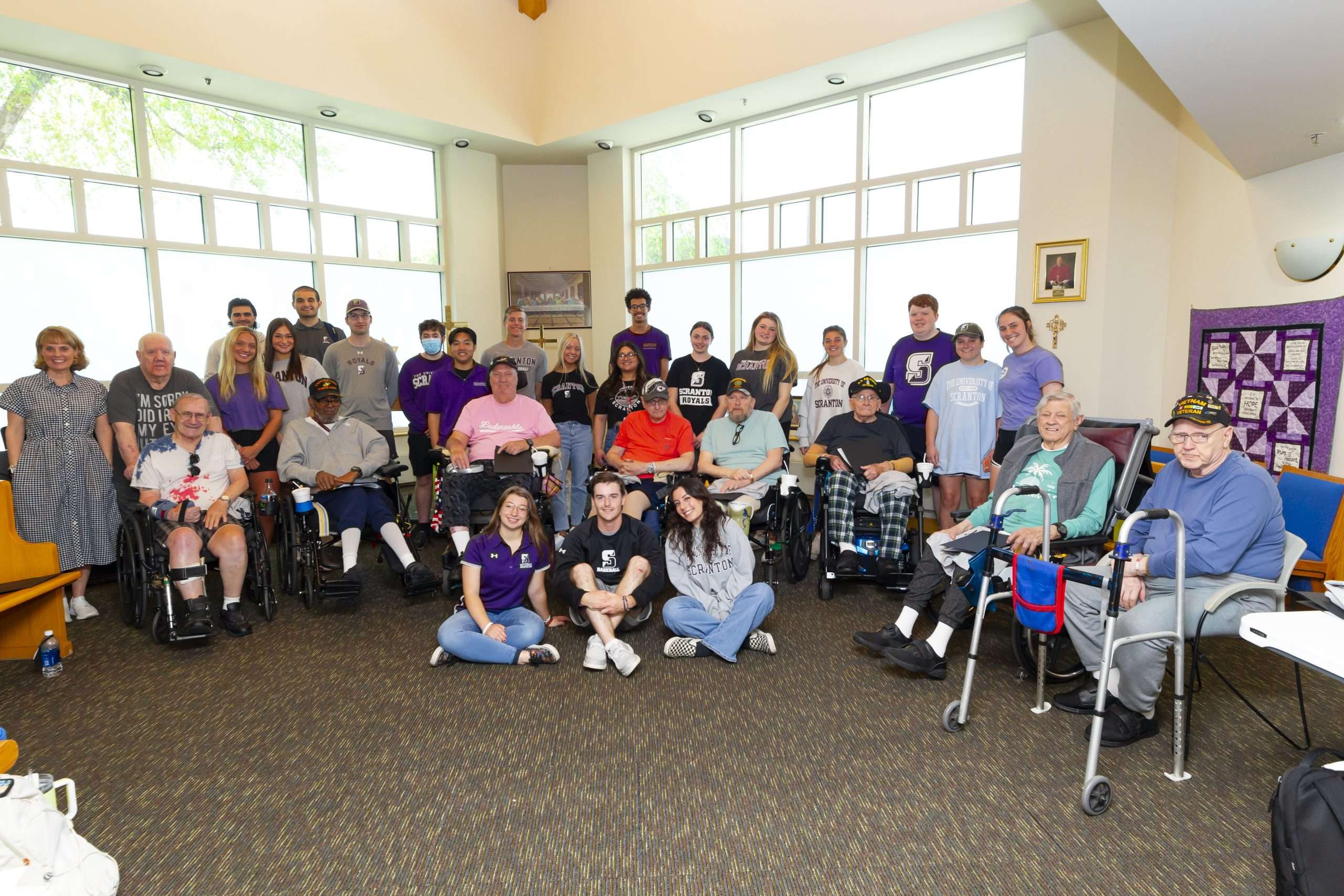
In the College of Arts and Sciences, Jessica Nolan, Ph.D., professor of Psychology and director of the Environmental and Sustainability Studies Concentration, integrates CBL into her Environmental and Conservation Psychology class. Students learn the tools and principles of community-based social marketing and then partner with organizations to apply those tools.
Dr. Nolan leads a CBL-driven environmental psychology class that, in her words, educates students about the “psychology behind a movement.” By applying psychological concepts learned in class, students harness community-based social marketing tools to make changes in human behavior that will benefit the environment. Examples include the following:
- Working with the Lackawanna County Office of Environmental Sustainability, students have participated in a local Earth Day Fair, engaging attendees in a recycling game designed to educate residents about what can and cannot be recycled in the county.
- Students partnered with Friends of Lackawanna to create social media posts designed to increase awareness and solicit donations for this local nonprofit that is committed to protecting the health, safety and environment of the local community.
- In support of the University’s Laudato Si’ initiatives, students worked with the Ecological Economics subcommittee to create a visual prompt designed to reduce printing, and collaborated with staff to post it on library computers.
Place-based learning is powerful in connecting students to the places where they are located. According to Dr. Nolan, humans connect to what they love. Cultivating a connection to nature is how we protect it.
In the LCHS, Michael Landram, Ph.D., associate professor of Health and Human Performance, leads a CBL initiative where Kinesiology students develop and implement strength and conditioning programs for older adults at the Jewish Community Center (JCC). Working alongside faculty mentors, senior students create exercise programs to help participants meet their immediate and longer-term goals. The initiative integrates content learned throughout the major’s curriculum and is required for graduation.
Key to the program is getting to know participants, many of whom have been part of this CBL for five years. Others are new and may not have done any structured activities for decades. This, according to Dr. Landram, is where students apply the Ignatian philosophy of cura personalis, or, caring for the whole person.
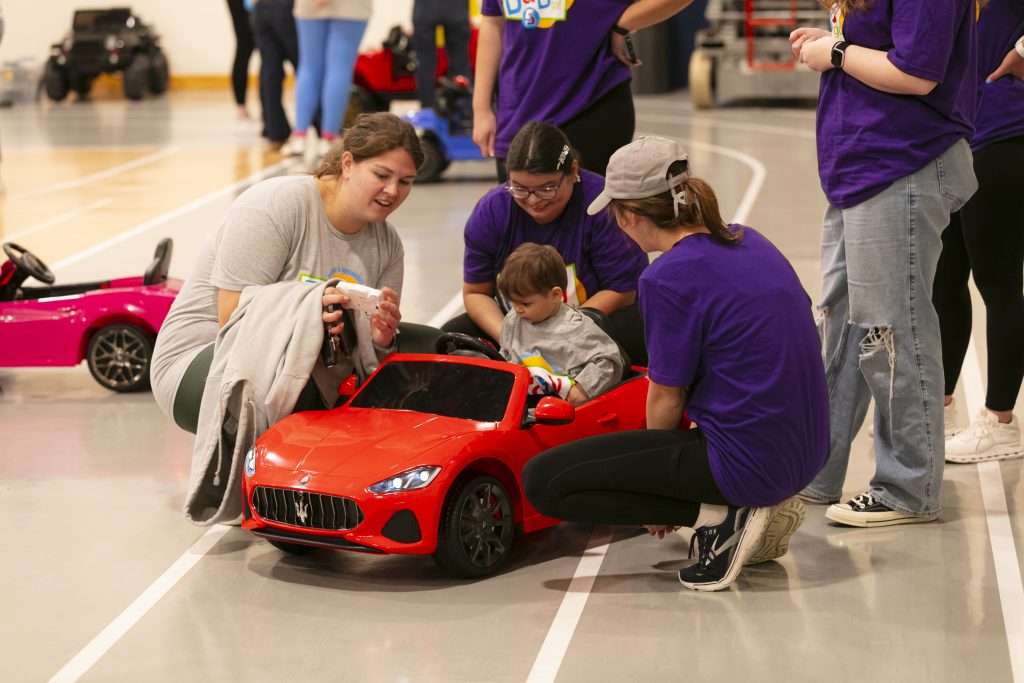
Students work with participants to develop appropriate activities that can be completed at the JCC facility, at home, or in their communities, with or without direct supervision. Participants identify their barriers to physical activity and students help address them through manageable and adaptable strength and conditioning programs.
Through reflection, students discern what they have learned, not just about health and human performance, but through their interactions with participants: the soft skills learned through “kitchen table talk” that helps students explain concepts to participants.
In the Kania School of Management, Ovidiu Cocieru, Ph.D., assistant professor of Management, Marketing and Entrepreneurship, teaches a sports event management course that integrates CBL. Students are organized into various roles of an event management company and are responsible, with faculty supervision, to plan and host a soccer tournament for local middle- and high-school students.
The students plan and implement the event from start to finish, learning everything from operations to event planning, marketing, and preparing for the unexpected. Most important, students learn how to work as an effective team, with everyone doing their part to keep operations running smoothly. The course culminates with a daylong soccer tournament held at the University’s Fitzpatrick Field. Dr. Cocieru says that the students are in awe when they see everything come together, as twenty teams compete in a tournament, the proceeds from which are donated to charity.
According to Dr. Cocieru, CBL is innovative among business schools due to the level of responsibility invested in students and the need to monitor the work and risks without being overbearing. In the end, however, students learn teamwork and business skills in real-time and in the real world. This, he says, gives students confidence and demonstrated skills that they can speak to in a job interview.
All three professors are quick to point out how the Magis is central to CBL. The personal connections that are developed by getting to know a soccer player, an older adult at the JCC, or an environmental advocate in the community are foundational to the student experience. For working in partnership, a transformative experience for student and community is created. That is what sets a Jesuit education apart.
By Debra Fetherman, Ph.D., Professor and Chair of the Department of Health and Human Performance and Community-Based Learning Faculty Coordinator, The University of Scranton.